
Patterns No. 5: Robots & Interest Rates, AI in Emergency Rooms, and the return of Public School NY
What I read this week (Sept 6 - Sept 12, 2026)

1) Are Robots Ruining the Treasury Market? (Bloomberg Podcasts: Everybody's Business)
“First they take our loans, then our jobs, then they kill us” is a very funny quip on how the robots are pushing interest rates up in this this fascinating podcast episode from Bloomberg. Essentially, are corporate bonds driven by AI projects in astronomical proportions squeezing out the US bond market:
As Papadopoulos explains, for a long time, US bonds were thriving in spite of mounting debt, trade wars, debt ceiling battles, political divisions and the like because they still looked like the best investment in the world.
But there’s a new investment in town, much to the chagrin of the US bond market: Robots. Apple, Amazon, Nvidia, Alphabet and other giant tech companies are borrowing billions of dollars to build data centers and other infrastructure for the artificial intelligence revolution. To do this, they have started issuing hundreds of billions of dollars worth of bonds. Corporate bonds have always existed, but they never came close to matching the size, scope and perceived safety of a US government bond. But these days, several tech companies have country-sized revenue and are decidedly global in their reach and sway. (The chances that Apple, Nvidia or Amazon will go broke and not pay you back for your bond are unlikely. Uncle Sam, on the other hand…).
The robot-bond boom means investors have lots of choices — lots of really good choices for super safe places to put their money. And, increasingly, bond issuers — from companies to countries — are having to offer more to compete for those dollars.
2) The jobs apocalypse is postponed. An AI jobs boom is here (The Economist)
Perhaps machines will make many humans unemployable eventually—but there is no sign of it yet. On September 4th the Bureau of Labour Statistics reported that the American economy added 162,000 jobs in August, far above expectations. The unemployment rate is 4.1%, lower than in almost 90% of months over the past half-century. Young workers, often cast as the first victims, of artificial intelligence, are doing just fine: the gap between unemployment among 20-24-year-olds and the overall rate is close to a multi-decade low.
There is a huge discrepancy (or “narrative violation” if you will) from the predicted job apocalypse brought by AI into what is actually happening. With more productivity unleashed by better, faster, and more capable models, there is more work to be done, and there is more demand for jobs than there is supply for it across both blue and white collar work, adding more jobs into the economy far above expectations.
I assume this trend will continue, crash or not, because like the internet created new jobs that we could not have dreamed of, AI will do the same. This isn't a novel assumption; it's just comforting to finally see how the evidence we have now—with staggering numbers at that—and we have enough data that goes back multiple years to see that what's happening is not a fluke but rather a compounding trend.
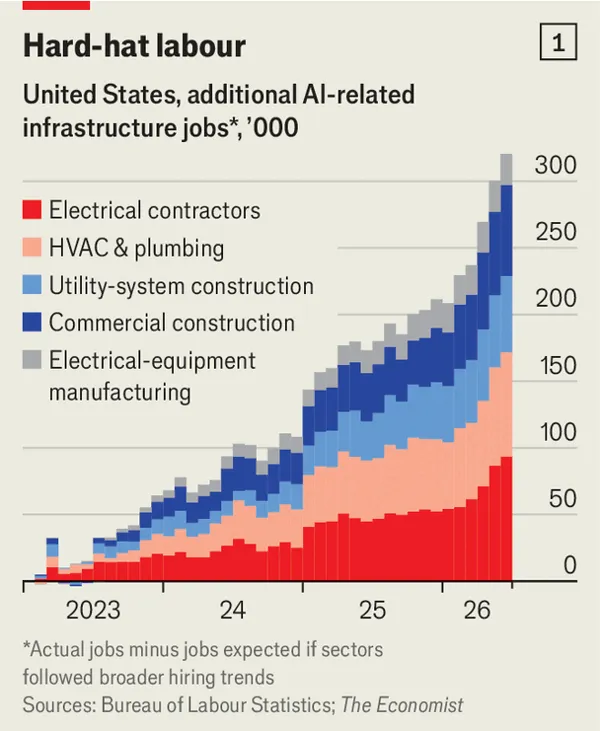
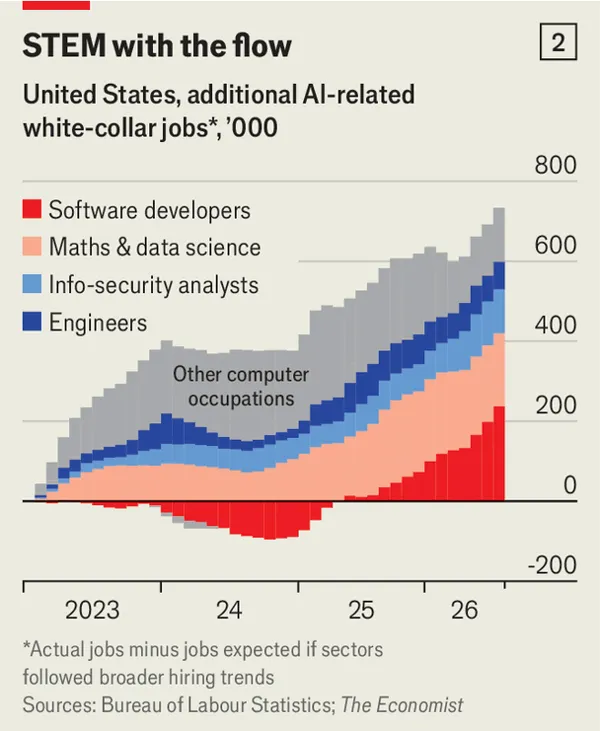
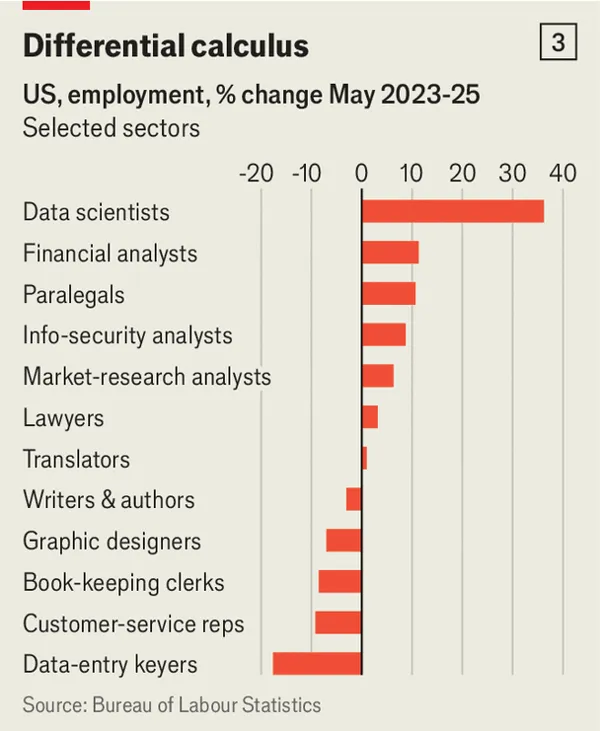
There will be ramifications of course: not every job will continue to increase and there will definitely be casualties; but value will accrue to areas where the augmentation of AI creates higher productivity which leads to higher returns. This ought not to be a surprise: long before AI, stability and wage growth has always been linked to: creating and protecting economic value, having fewer people do something well, and businesses being able to capture enough value to distribute it to workers. We're just seeing another era of this before our eyes, similar to what the computer revolution has done to previous generations.
3) Transformation doesn’t happen in the boardroom (Fast Company)

Every company is going through a transformation right now. This article is a good reminder of how to execute transformation: it doesn't happen in the C-Suite discussing strategy; rather, it's deployed when the every day operations of the frontline worker is made easier.
Multiply that across your workforce, in tiny decisions every single day, and that's how transformation happens (emphasis mine):
Executives spend significant time developing and defining strategy. But that strategy’s success depends on thousands of decisions made far from the executive suite.
Earlier in my career, I tended to think about transformation in terms of major programs: the technology deployed, the process redesigned, or the milestone achieved. Over time, I’ve come to believe the more revealing test is much smaller. What became easier for a manager on Tuesday morning because of it?
When managers must manually connect information across scheduling, time, pay, skills, and other systems, we create friction in the point where organizations need speed.
The lesson for leaders is to examine transformation from the frontline backward. What decisions do our people make every day? What information do they need at that moment? How many systems must they navigate to get it?
Transformation becomes much more tangible when we start measuring it by what now works better.
[...] Ultimately, transformation becomes real when the new way of working becomes the easiest way of working.
4) Can AI fix health care? In the chaos of emergency rooms, the technology comes up short (StatNews)
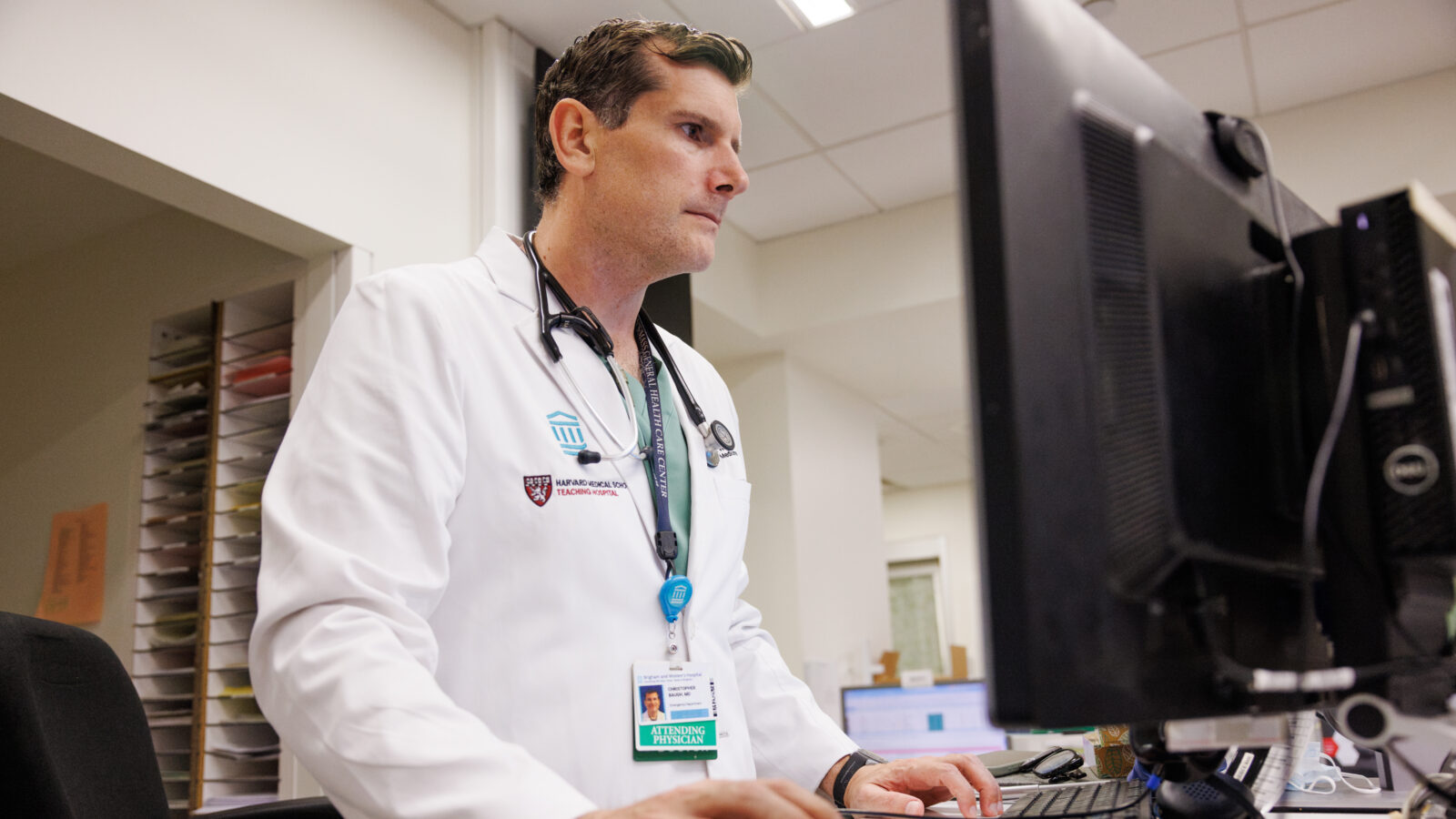
With all the optimism of AI in healthcare, this article from StatNews is a well-reported and sobering story on the minimal impact of AI in emergency rooms.
While AI scribes have their pros and adoption is now widespread among clinicians and has increasingly gotten better (it's much harder in the ER with multiple people talking at the same time, with loud beeps everywhere, and the speed at how things go), the technology has not yet spread to other areas of the ER:
An AI scribe “is one of the lowest hanging fruits” for AI, said Josh Lesko, who works for a Virginia group called the Emergency Physicians of Tidewater that staffs the Sentara health system. “It’s a much easier and simpler fix than ED boarding or patient discharge rates, which have plagued the hospital system.”
MGB didn’t even expect the AI tool to affect patient throughput because of how full of bottlenecks the ED is, Dutta said. “If you’ve got a lot of boarders, for example, that can’t get a bed upstairs, you may not be able to impact how many patients you see because you’re constrained by these other things that are outside of your control, to some extent,” he said.
Other generative AI tools in the pipeline for the emergency department — such as creating discharge instructions in simpler or other languages, triaging patients, summarizing a patient’s complex medical history for ED physicians, suggesting diagnoses and next steps, or bringing the most urgent radiology scans to the front of the line — are far behind AI scribes.
Scribes are great but so far it seems like a local optimization in a system as complex as emergency rooms where there are bottlenecks galore in every step. This is a fascinating case study to evaluate for designers and healthcare leaders: there's still a lot of work to do and improvement in one area cannot be touted as transformational improvement of the broader system.
AI is powerful and it can impact many parts of the value chain, but many of healthcare's biggest problems are not yet being solved by AI:
There are “dozens of issues in health care that need addressing, arguably maybe even more than improving and fixing the rev[enue] cycle and prior auth[orization],” said Walker, referencing the billing and insurance applications of AI that are also currently among the most popular uses of AI in medicine. He listed infant mortality, rural health, maternal mortality, and under-insurance as bigger issues, just to start.
“But those problems are so perpendicular to what AI can do right now,” he said.
5) Public School’s Maxwell Osborne and Dao-Yi Chow on Their Epic Comeback, Nike ACG Collab, and Why NYFW Still Matters (GQ)

GQ: How has the menswear landscape changed since you took the hiatus
Osborne: Fashion has changed.
Chow: More men care about clothes than they ever have. It’s not even about clothes, it’s about anything that’s personal to them, anything that’s part of their identity. I think people nowadays have discovered how powerful fashion is as a tool to be able to align yourself with your tribe, or your group, or your set of morals, or how you want people to portray you. Naturally, the more attention, the more opportunity there is for new brands that come into the landscape.
I think with the rise of the athlete as sort of the muse, at least in menswear, you have a lot more cohorts [for men] to look at and aspire to or relate to. There are more access points and people are seeing it and incorporating it into their lives more than they ever have before.
Cool to see the boys back. And the new collection is dope: broad silhouettes, wide lapels, relaxed bottoms are back, but with finer and lighter fabrics, and simple hues which emphasize the clothing and the craftsmanship. And the campaign shots are awesome (like this video); feels like you're taken back to a Dead Presidents music video or Hype Williams' Belly from the '90s.